Beach Cleanup - Research & Development Methods
Beach Cleanup - Research & Development Methods
🔍 Project Overview
Beach cleanups are mostly done by volunteers, but they don’t have the right tools to make the work easier. The tools available today are limited and solve only one problem at a time. Because of this, cleaning beaches takes a lot of effort and time.
People cleaning beaches face many challenges such as digging waste out of sand, collecting it, cleaning it, moving it, and separating different types of waste. There is no single solution that helps with all these tasks.
This project aims to create a better tool for beach cleanups. The goal is to design a modular tool or improve existing machines so they can handle multiple tasks. The solution focuses on making beach cleaning faster, easier, and less tiring for people involved in cleanup efforts.
🧾 Problem Statement
Individuals who clean beaches do not have access to a single, easy-to-use tool that helps with digging, collecting, cleaning, transporting, and separating waste. Existing tools solve only parts of the problem, making beach cleanups tiring, slow, and inefficient. There is a need for a simple, effective beach cleanup tool that supports individual efforts and makes cleaning beaches easier—because cleaner beaches lead to cleaner oceans.
🧭 Research Process
Identify:
Initial brief - The goal of this project was to design the perfect beach cleanup tool for individuals. Cleaning beaches is an important step toward reducing ocean pollution. The tool needed to make beach cleaning easier, faster, and more efficient for everyday users.
Mind map - We created a mind map to better understand the problem and explore all possible solutions. It helped us break down key challenges in beach cleanup such as digging, collecting waste, cleaning debris, carrying trash, and waste segregation. The mind map allowed us to connect problems with ideas and identify opportunities for a modular or retrofit tool.
Timeline - We used a timeline to plan the project step by step. It helped us divide the work into clear phases research, ideation, prototyping, testing, and final design. The timeline ensured that the project stayed organized and progressed smoothly from start to finish.
Secondary Research:
Discovering the Problem - My research journey began with understanding the scale of beach pollution. I learned that less than 9% of disposable plastic gets recycled, and 7 billion tons of debris ends up on beaches annually. This waste includes algae, oil, sewage, and mismanaged waste. What struck me was why sand health matters—it's a vital habitat, acts as a natural water filter, and recycles nutrients for marine ecosystems.
What's Already Out There - I explored existing solutions and found two extremes. Massive industrial machines like BeachTech Sweepy and Clean Sand Barracuda weigh 180-420 kilograms, clean thousands of square meters per hour, but require vehicles, trained operators, and cost thousands of dollars—clearly not for everyday beach-goers.
On the other end, I found the SandRagin, weighing less than a kilogram. It's a rolling mesh cylinder that sifts sand as you push it. While cheap, compact, and easy to use, it only works on dry sand, isn't sturdy, and can't capture microplastics—the biggest threat to marine life.
Understanding the SandRagin's Potential - Despite its flaws, I studied the SandRagin because it represented the right approach—a tool for speed over what individuals need: light weight, affordability, easy storage, and simple operation. The market research revealed no stable market for individual tools—companies focus on selling expensive equipment to municipalities, leaving passionate individuals without proper tools. Its strengths included minimal moving parts, easy maneuverability, and accessible materials. However, it couldn't rotate, fell apart easily, and the mesh wasn't fine enough for microplastics.
This analysis revealed opportunities: a nested finer mesh system for simultaneous collection and sorting, a raking mechanism for wet sand, motorization options, or even a beach rental system like airport luggage trolleys.
Learning from Other Individual Tools - I researched smaller solutions worldwide. SeaHugger's DIY Beach Clean Ups with their "Track Your Trash" system lets individuals contribute data. The Pieces Collector, made from abandoned fishing nets, showed circular design thinking. The Microplastic Filter Pipe had excellent filtration technology that could be adapted for sand. Even playful solutions like cleanup toys and special slippers showed creative thinking about individual contributions.
The Critical Insight - After creating comparison charts and perceptual maps, a pattern emerged: heavier machines cover more area but are impossible for individuals to use. Lightweight tools are portable but can't collect the smallest, most dangerous particles.
My key insight: the market has it backwards. Big machines collect large trash—items easily picked up by hand—while almost nothing captures microplastics and microfibers that individuals can't see but cause the most harm to marine ecosystems.
Identifying the Opportunity - No existing tools sort trash after collection, making recycling harder. Industrial solutions prioritize
Primary Research:
Research Approach - To understand actual beach cleaning experiences, I conducted comprehensive primary research using multiple methods: quantitative questionnaires for patterns, qualitative interviews for deeper insights, shadowing to observe real cleanups, and personal interviews with regular beach cleaners. I organized findings through affinity mapping and created "How Might We" questions to frame design opportunities.
What Tools Are People Using? - My questionnaire revealed people rely on basic household tools never designed for beach cleanup: gloves, plastic rakes, grabbers, buckets, and shovels—the same tools used for gardening. This confirmed my secondary research—people make do with whatever they can find because proper individual beach cleanup tools don't exist.
The Physical Toll - The most eye-opening discovery was how cleanups affect people's bodies. Respondents reported serious back pain, shoulder strain, and knee problems from constantly bending, crouching, and lifting. When asked what activity was most difficult, answers clustered around collection and digging—the repetitive bending and effort to sift through sand. This revealed a critical need: any tool must reduce physical strain, not add to it.
Safety Concerns - Through shadowing and interviews, I uncovered safety problems cleaners face: sharp objects hidden in sand (broken glass, metal, needles), inadequate glove protection, and concerns about handling contaminated waste. Current tools don't adequately protect users, and there's no safe way to sort collected debris without directly handling potentially dangerous items.
The Collection and Sorting Problem - Problems don't end after collection. Everything gets mixed together—recyclables with non-recyclables, hazardous items with regular trash. My data showed most people dispose of everything together because sorting dirty, mixed waste after hours of physical labor is too unpleasant. This revealed an opportunity: if sorting happened during collection rather than after, it would actually get done.
Types of Waste Encountered - I mapped various waste types and their challenges. Large items like bottles are easy to spot but labor-intensive. Smaller items—cigarette butts, caps, wrappers—are numerous and harder to gather. Microplastics are invisible or too small to pick up by hand. I also discovered unique categories: religious offerings requiring cultural sensitivity, and sewage-related waste raising health concerns.
The Microplastics Gap - When I asked about microplastics, I found a disconnect. Most knew they were harmful but had no idea how to collect them. Some thought only scientists could address this. Others didn't realize microplastics were present on beaches they cleaned. People wanted to help but lacked tools and knowledge.
Why People Don't Participate - My questionnaire on reluctance revealed key barriers: physical difficulty and time commitment topped the list. Lack of proper tools was frequent—people felt ill-equipped. Others mentioned not knowing how to start, feeling individual effort wouldn't matter, weather concerns, lack of disposal options, and worries about handling hazardous waste.
Feedback on Existing Solutions - I showed participants the SandRagin and industrial machines. Large machines seemed impractical—too expensive, heavy, requiring vehicles. The SandRagin generated interest for its size and simplicity, but people quickly spotted limitations: not sturdy enough, questionable on wet sand and too coarse for small debris. It looked more like a garden tool than beach-specific equipment.
Qualitative Research: We conducted personal interviews with beach cleaners, including:
Mahek and Anavid (scheduled for 23/9/21)
Joshua (scheduled for 23/9/21)
Outreach to Chinu Kwatra (Dadar Beach Cleanup leader)
Contact with Afroz Shah (lawyer who headed the Versova Beach Cleanup - world's largest beach cleanup project)
Key Insights and Design Opportunities
After affinity mapping, several insights emerged
Physical Strain: Current methods cause body pain. How might we minimize bending and repetitive strain?
Safety: Cleaners encounter hazards without protection. How might we protect users from sharp objects and contaminated waste?
Sorting: Post-collection sorting rarely happens due to exhaustion. How might we enable sorting during collection?
Microplastics: People want to help but lack means. How might we make microplastic collection accessible to individuals?
Participation Barriers: Difficulty and inadequate tools prevent involvement. How might we make cleaning easier to encourage participation?
Tool Gap: Generic tools aren't beach-specific. How might we create purpose built tools for sand, water, and various waste types?
Ideation:
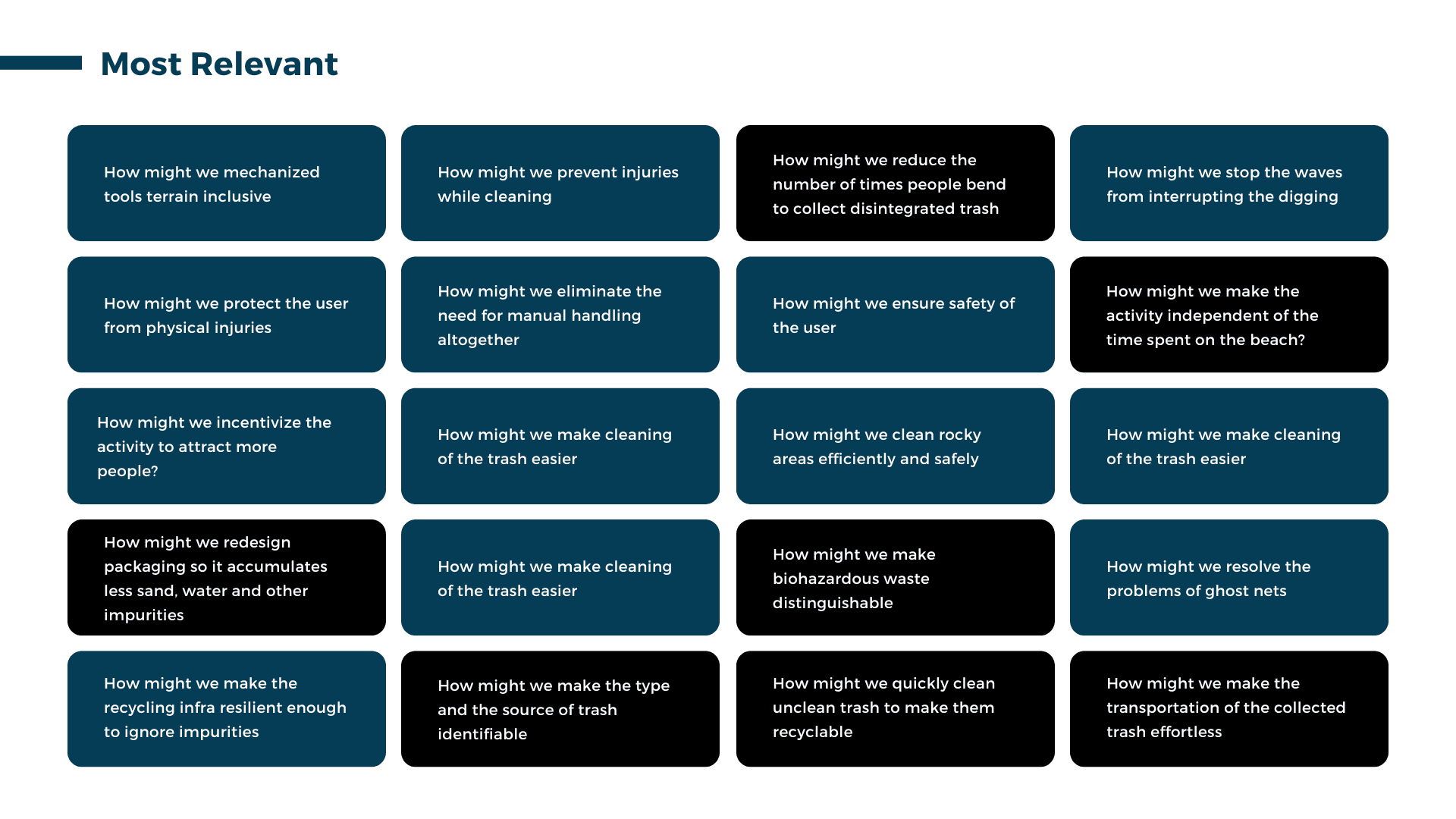
Our team conducted a structured ideation exercise focused on beach clean-up challenges. We explored four key problem areas through "How Might We" (HMW) questions, generating over 130 concept sketches across the team.
The ideation was organized around these design challenges:
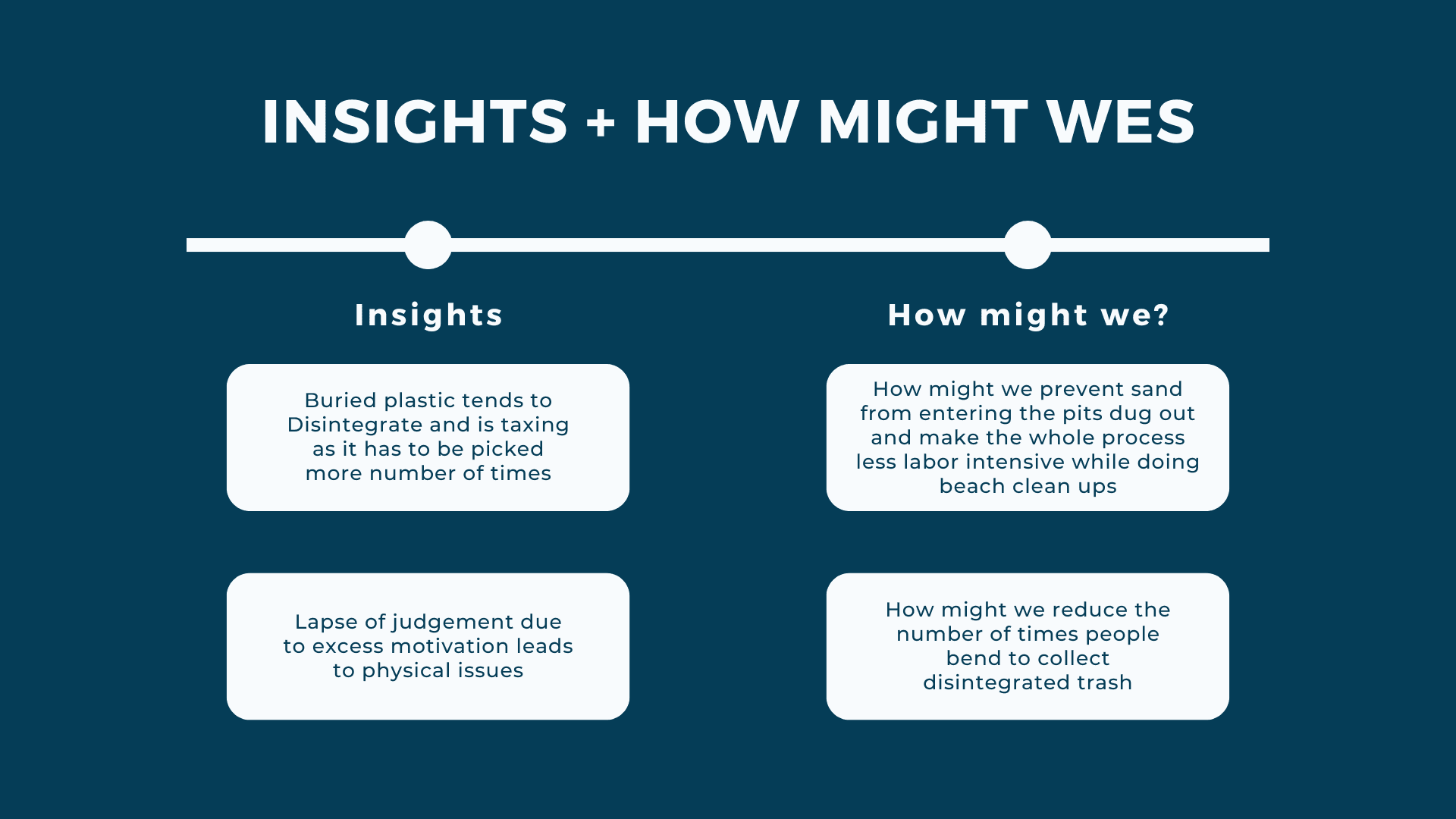
HMW #1: Preventing sand from entering pits and reducing labor intensity - We generated ideas ranging from physical barriers and specialized scooping tools to alternative collection methods that minimize digging altogether.
HMW #2: Reducing bending motions when collecting disintegrated trash - Solutions explored improved posture through extended handles, wheeled collection devices, and methods to make small trash more visible and easier to identify before bending.
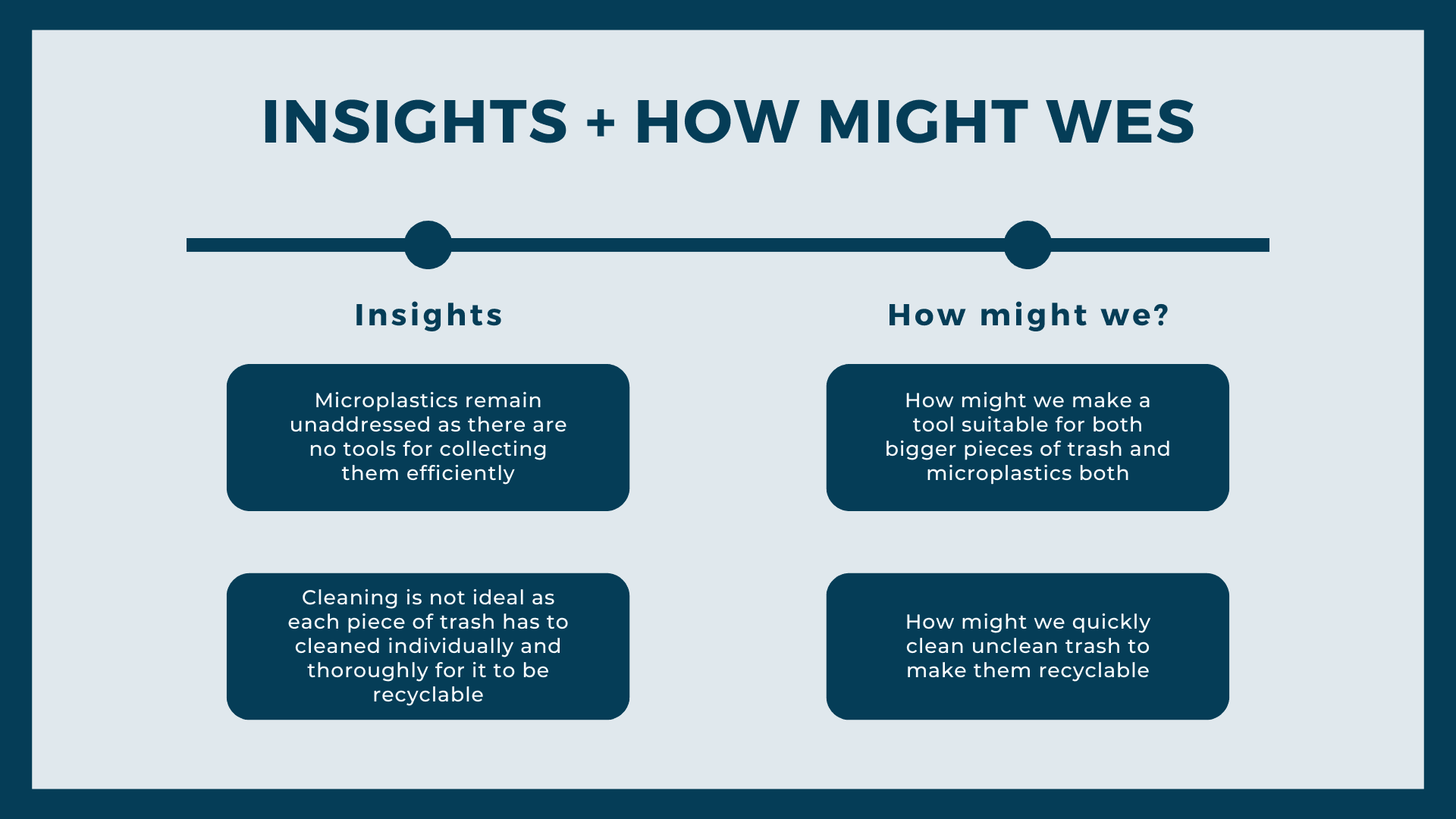
HMW #3: Creating tools for both large trash and microplastics - Concepts included dual-function tools, interchangeable attachments, and screening mechanisms that could handle varying debris sizes.
HMW #4: Quickly cleaning unclean trash for recycling - Ideas focused on portable washing systems, wiping mechanisms, and separation methods to prepare contaminated items for proper recycling.
Idea selection process
We implemented a four-stage selection process:
Stage 1: Ranking We established design criteria:
Must Haves:
Scalable
Modularity
Multipurpose
Easy to manufacture
Safe
Ergonomic
May Haves:
Terrain inclusive
Transportable
Mechanical
Large capacity
Must Not Have:
Expensive
Resource intensive
Heavy
Stage 2: Shortlisting - Ideas with highest scores were identified
Stage 3: Final Selection - Top concepts were chosen for development
Stage 4: Impact-Effort Grid We evaluated final ideas using two lenses:
Use perspective (user impact vs. effort to use)
Manufacturing perspective (impact vs. effort to manufacture)
🧠 Solution
SNIGER is a portable, fully mechanical beach cleanup tool designed for individuals who want an efficient, low-effort way to clean beaches. It reduces bending, prevents sand from mixing with collected trash, and makes cleanup less physically demanding, allowing users to clean longer with less strain.
How It Works
The tool combines a cylindrical mesh sieve, a turn-able rake, and a push lever handle. Users push SNIGER across the sand; the rake loosens debris into the sieve while sand falls through. Once full, the sieve tilts via a rotating hinge for easy disposal. The tool then resets for continuous cleanup without heavy lifting.
Key Advantages
Reduces bending and physical strain
Prevents sand from entering the collection area
Fully mechanical—no power needed
Portable, modular, and easy to transport
Safe, ergonomic, and works on various debris sizes
Design Philosophy
SNIGER is user-centered, prioritizing volunteers’ comfort and safety. By making beach cleanup easier and sustainable, it encourages long-term participation and healthier engagement with the environment.
💡Reflection
Our research process successfully identified critical pain points through comprehensive primary and qualitative research with active beach cleaners, leading to SNIGER - a mechanical tool that directly addresses the most urgent needs of reducing repetitive bending and preventing sand contamination. The structured ideation and four-stage selection process was effective in narrowing 130+ concepts to a viable solution. However, we have significant gaps including limited prototype testing, unclear performance on wet sand and microplastics collection, undefined material specifications and costs, and awaiting feedback from key stakeholders like Afroz Shah and Chinu Kwatra. The design appears optimized for individual volunteers on dry sand but doesn't fully address all four HMW questions, particularly the cleaning mechanism for recyclability.
🔍 Project Overview
Beach cleanups are mostly done by volunteers, but they don’t have the right tools to make the work easier. The tools available today are limited and solve only one problem at a time. Because of this, cleaning beaches takes a lot of effort and time.
People cleaning beaches face many challenges such as digging waste out of sand, collecting it, cleaning it, moving it, and separating different types of waste. There is no single solution that helps with all these tasks.
This project aims to create a better tool for beach cleanups. The goal is to design a modular tool or improve existing machines so they can handle multiple tasks. The solution focuses on making beach cleaning faster, easier, and less tiring for people involved in cleanup efforts.
🧾 Problem Statement
Individuals who clean beaches do not have access to a single, easy-to-use tool that helps with digging, collecting, cleaning, transporting, and separating waste. Existing tools solve only parts of the problem, making beach cleanups tiring, slow, and inefficient. There is a need for a simple, effective beach cleanup tool that supports individual efforts and makes cleaning beaches easier—because cleaner beaches lead to cleaner oceans.
🧭 Research Process
Identify:
Initial brief - The goal of this project was to design the perfect beach cleanup tool for individuals. Cleaning beaches is an important step toward reducing ocean pollution. The tool needed to make beach cleaning easier, faster, and more efficient for everyday users.
Mind map - We created a mind map to better understand the problem and explore all possible solutions. It helped us break down key challenges in beach cleanup such as digging, collecting waste, cleaning debris, carrying trash, and waste segregation. The mind map allowed us to connect problems with ideas and identify opportunities for a modular or retrofit tool.
Timeline - We used a timeline to plan the project step by step. It helped us divide the work into clear phases research, ideation, prototyping, testing, and final design. The timeline ensured that the project stayed organized and progressed smoothly from start to finish.
Secondary Research:
Discovering the Problem - My research journey began with understanding the scale of beach pollution. I learned that less than 9% of disposable plastic gets recycled, and 7 billion tons of debris ends up on beaches annually. This waste includes algae, oil, sewage, and mismanaged waste. What struck me was why sand health matters—it's a vital habitat, acts as a natural water filter, and recycles nutrients for marine ecosystems.
What's Already Out There - I explored existing solutions and found two extremes. Massive industrial machines like BeachTech Sweepy and Clean Sand Barracuda weigh 180-420 kilograms, clean thousands of square meters per hour, but require vehicles, trained operators, and cost thousands of dollars—clearly not for everyday beach-goers.
On the other end, I found the SandRagin, weighing less than a kilogram. It's a rolling mesh cylinder that sifts sand as you push it. While cheap, compact, and easy to use, it only works on dry sand, isn't sturdy, and can't capture microplastics—the biggest threat to marine life.
Understanding the SandRagin's Potential - Despite its flaws, I studied the SandRagin because it represented the right approach—a tool for speed over what individuals need: light weight, affordability, easy storage, and simple operation. The market research revealed no stable market for individual tools—companies focus on selling expensive equipment to municipalities, leaving passionate individuals without proper tools. Its strengths included minimal moving parts, easy maneuverability, and accessible materials. However, it couldn't rotate, fell apart easily, and the mesh wasn't fine enough for microplastics.
This analysis revealed opportunities: a nested finer mesh system for simultaneous collection and sorting, a raking mechanism for wet sand, motorization options, or even a beach rental system like airport luggage trolleys.
Learning from Other Individual Tools - I researched smaller solutions worldwide. SeaHugger's DIY Beach Clean Ups with their "Track Your Trash" system lets individuals contribute data. The Pieces Collector, made from abandoned fishing nets, showed circular design thinking. The Microplastic Filter Pipe had excellent filtration technology that could be adapted for sand. Even playful solutions like cleanup toys and special slippers showed creative thinking about individual contributions.
The Critical Insight - After creating comparison charts and perceptual maps, a pattern emerged: heavier machines cover more area but are impossible for individuals to use. Lightweight tools are portable but can't collect the smallest, most dangerous particles.
My key insight: the market has it backwards. Big machines collect large trash—items easily picked up by hand—while almost nothing captures microplastics and microfibers that individuals can't see but cause the most harm to marine ecosystems.
Identifying the Opportunity - No existing tools sort trash after collection, making recycling harder. Industrial solutions prioritize.
Primary Research:
Research Approach - To understand actual beach cleaning experiences, I conducted comprehensive primary research using multiple methods: quantitative questionnaires for patterns, qualitative interviews for deeper insights, shadowing to observe real cleanups, and personal interviews with regular beach cleaners. I organized findings through affinity mapping and created "How Might We" questions to frame design opportunities.
What Tools Are People Using? - My questionnaire revealed people rely on basic household tools never designed for beach cleanup: gloves, plastic rakes, grabbers, buckets, and shovels—the same tools used for gardening. This confirmed my secondary research—people make do with whatever they can find because proper individual beach cleanup tools don't exist.
The Physical Toll - The most eye-opening discovery was how cleanups affect people's bodies. Respondents reported serious back pain, shoulder strain, and knee problems from constantly bending, crouching, and lifting. When asked what activity was most difficult, answers clustered around collection and digging—the repetitive bending and effort to sift through sand. This revealed a critical need: any tool must reduce physical strain, not add to it.
Safety Concerns - Through shadowing and interviews, I uncovered safety problems cleaners face: sharp objects hidden in sand (broken glass, metal, needles), inadequate glove protection, and concerns about handling contaminated waste. Current tools don't adequately protect users, and there's no safe way to sort collected debris without directly handling potentially dangerous items.
The Collection and Sorting Problem - Problems don't end after collection. Everything gets mixed together—recyclables with non-recyclables, hazardous items with regular trash. My data showed most people dispose of everything together because sorting dirty, mixed waste after hours of physical labor is too unpleasant. This revealed an opportunity: if sorting happened during collection rather than after, it would actually get done.
Types of Waste Encountered - I mapped various waste types and their challenges. Large items like bottles are easy to spot but labor-intensive. Smaller items—cigarette butts, caps, wrappers—are numerous and harder to gather. Microplastics are invisible or too small to pick up by hand. I also discovered unique categories: religious offerings requiring cultural sensitivity, and sewage-related waste raising health concerns.
The Microplastics Gap - When I asked about microplastics, I found a disconnect. Most knew they were harmful but had no idea how to collect them. Some thought only scientists could address this. Others didn't realize microplastics were present on beaches they cleaned. People wanted to help but lacked tools and knowledge.
Why People Don't Participate - My questionnaire on reluctance revealed key barriers: physical difficulty and time commitment topped the list. Lack of proper tools was frequent—people felt ill-equipped. Others mentioned not knowing how to start, feeling individual effort wouldn't matter, weather concerns, lack of disposal options, and worries about handling hazardous waste.
Feedback on Existing Solutions - I showed participants the SandRagin and industrial machines. Large machines seemed impractical—too expensive, heavy, requiring vehicles. The SandRagin generated interest for its size and simplicity, but people quickly spotted limitations: not sturdy enough, questionable on wet sand and too coarse for small debris. It looked more like a garden tool than beach-specific equipment.
Qualitative Research: We conducted personal interviews with beach cleaners, including:
Mahek and Anavid (scheduled for 23/9/21)
Joshua (scheduled for 23/9/21)
Outreach to Chinu Kwatra (Dadar Beach Cleanup leader)
Contact with Afroz Shah (lawyer who headed the Versova Beach Cleanup - world's largest beach cleanup project)
Key Insights and Design Opportunities
After affinity mapping, several insights emerged
Physical Strain: Current methods cause body pain. How might we minimize bending and repetitive strain?
Safety: Cleaners encounter hazards without protection. How might we protect users from sharp objects and contaminated waste?
Sorting: Post-collection sorting rarely happens due to exhaustion. How might we enable sorting during collection?
Microplastics: People want to help but lack means. How might we make microplastic collection accessible to individuals?
Participation Barriers: Difficulty and inadequate tools prevent involvement. How might we make cleaning easier to encourage participation?
Tool Gap: Generic tools aren't beach-specific. How might we create purpose built tools for sand, water, and various waste types?
Ideation:
Our team conducted a structured ideation exercise focused on beach clean-up challenges. We explored four key problem areas through "How Might We" (HMW) questions, generating over 130 concept sketches across the team.
The ideation was organized around these design challenges:
HMW #1: Preventing sand from entering pits and reducing labor intensity - We generated ideas ranging from physical barriers and specialized scooping tools to alternative collection methods that minimize digging altogether.
HMW #2: Reducing bending motions when collecting disintegrated trash - Solutions explored improved posture through extended handles, wheeled collection devices, and methods to make small trash more visible and easier to identify before bending.
HMW #3: Creating tools for both large trash and microplastics - Concepts included dual-function tools, interchangeable attachments, and screening mechanisms that could handle varying debris sizes.
HMW #4: Quickly cleaning unclean trash for recycling - Ideas focused on portable washing systems, wiping mechanisms, and separation methods to prepare contaminated items for proper recycling.
Idea selection process
We implemented a four-stage selection process:
Stage 1: Ranking We established design criteria:
Must Haves:
Scalable
Modularity
Multipurpose
Easy to manufacture
Safe
Ergonomic
May Haves:
Terrain inclusive
Transportable
Mechanical
Large capacity
Must Not Have:
Expensive
Resource intensive
Heavy
Stage 2: Shortlisting - Ideas with highest scores were identified
Stage 3: Final Selection - Top concepts were chosen for development
Stage 4: Impact-Effort Grid We evaluated final ideas using two lenses:
Use perspective (user impact vs. effort to use)
Manufacturing perspective (impact vs. effort to manufacture)
🧠 Solution
SNIGER is a portable, fully mechanical beach cleanup tool designed for individuals who want an efficient, low-effort way to clean beaches. It reduces bending, prevents sand from mixing with collected trash, and makes cleanup less physically demanding, allowing users to clean longer with less strain.
How It Works
The tool combines a cylindrical mesh sieve, a turn-able rake, and a push lever handle. Users push SNIGER across the sand; the rake loosens debris into the sieve while sand falls through. Once full, the sieve tilts via a rotating hinge for easy disposal. The tool then resets for continuous cleanup without heavy lifting.
Key Advantages
Reduces bending and physical strain
Prevents sand from entering the collection area
Fully mechanical—no power needed
Portable, modular, and easy to transport
Safe, ergonomic, and works on various debris sizes
Design Philosophy
SNIGER is user-centered, prioritizing volunteers’ comfort and safety. By making beach cleanup easier and sustainable, it encourages long-term participation and healthier engagement with the environment.
💡Reflection
Our research process successfully identified critical pain points through comprehensive primary and qualitative research with active beach cleaners, leading to SNIGER - a mechanical tool that directly addresses the most urgent needs of reducing repetitive bending and preventing sand contamination. The structured ideation and four-stage selection process was effective in narrowing 130+ concepts to a viable solution. However, we have significant gaps including limited prototype testing, unclear performance on wet sand and microplastics collection, undefined material specifications and costs, and awaiting feedback from key stakeholders like Afroz Shah and Chinu Kwatra. The design appears optimized for individual volunteers on dry sand but doesn't fully address all four HMW questions, particularly the cleaning mechanism for recyclability.
🔍 Project Overview
Beach cleanups are mostly done by volunteers, but they don’t have the right tools to make the work easier. The tools available today are limited and solve only one problem at a time. Because of this, cleaning beaches takes a lot of effort and time.
People cleaning beaches face many challenges such as digging waste out of sand, collecting it, cleaning it, moving it, and separating different types of waste. There is no single solution that helps with all these tasks.
This project aims to create a better tool for beach cleanups. The goal is to design a modular tool or improve existing machines so they can handle multiple tasks. The solution focuses on making beach cleaning faster, easier, and less tiring for people involved in cleanup efforts.
🧾 Problem Statement
Individuals who clean beaches do not have access to a single, easy-to-use tool that helps with digging, collecting, cleaning, transporting, and separating waste. Existing tools solve only parts of the problem, making beach cleanups tiring, slow, and inefficient. There is a need for a simple, effective beach cleanup tool that supports individual efforts and makes cleaning beaches easier—because cleaner beaches lead to cleaner oceans.
🧭 Research Process
Identify:
Initial brief - The goal of this project was to design the perfect beach cleanup tool for individuals. Cleaning beaches is an important step toward reducing ocean pollution. The tool needed to make beach cleaning easier, faster, and more efficient for everyday users.
Mind map - We created a mind map to better understand the problem and explore all possible solutions. It helped us break down key challenges in beach cleanup such as digging, collecting waste, cleaning debris, carrying trash, and waste segregation. The mind map allowed us to connect problems with ideas and identify opportunities for a modular or retrofit tool.
Timeline - We used a timeline to plan the project step by step. It helped us divide the work into clear phases research, ideation, prototyping, testing, and final design. The timeline ensured that the project stayed organized and progressed smoothly from start to finish.
Secondary Research:
Discovering the Problem - My research journey began with understanding the scale of beach pollution. I learned that less than 9% of disposable plastic gets recycled, and 7 billion tons of debris ends up on beaches annually. This waste includes algae, oil, sewage, and mismanaged waste. What struck me was why sand health matters—it's a vital habitat, acts as a natural water filter, and recycles nutrients for marine ecosystems.
What's Already Out There - I explored existing solutions and found two extremes. Massive industrial machines like BeachTech Sweepy and Clean Sand Barracuda weigh 180-420 kilograms, clean thousands of square meters per hour, but require vehicles, trained operators, and cost thousands of dollars—clearly not for everyday beach-goers.
On the other end, I found the SandRagin, weighing less than a kilogram. It's a rolling mesh cylinder that sifts sand as you push it. While cheap, compact, and easy to use, it only works on dry sand, isn't sturdy, and can't capture microplastics—the biggest threat to marine life.
Understanding the SandRagin's Potential - Despite its flaws, I studied the SandRagin because it represented the right approach—a tool for speed over what individuals need: light weight, affordability, easy storage, and simple operation. The market research revealed no stable market for individual tools—companies focus on selling expensive equipment to municipalities, leaving passionate individuals without proper tools. Its strengths included minimal moving parts, easy maneuverability, and accessible materials. However, it couldn't rotate, fell apart easily, and the mesh wasn't fine enough for microplastics.
This analysis revealed opportunities: a nested finer mesh system for simultaneous collection and sorting, a raking mechanism for wet sand, motorization options, or even a beach rental system like airport luggage trolleys.
Learning from Other Individual Tools - I researched smaller solutions worldwide. SeaHugger's DIY Beach Clean Ups with their "Track Your Trash" system lets individuals contribute data. The Pieces Collector, made from abandoned fishing nets, showed circular design thinking. The Microplastic Filter Pipe had excellent filtration technology that could be adapted for sand. Even playful solutions like cleanup toys and special slippers showed creative thinking about individual contributions.
The Critical Insight - After creating comparison charts and perceptual maps, a pattern emerged: heavier machines cover more area but are impossible for individuals to use. Lightweight tools are portable but can't collect the smallest, most dangerous particles.
My key insight: the market has it backwards. Big machines collect large trash—items easily picked up by hand—while almost nothing captures microplastics and microfibers that individuals can't see but cause the most harm to marine ecosystems.
Identifying the Opportunity - No existing tools sort trash after collection, making recycling harder. Industrial solutions prioritize.
Primary Research:
Research Approach - To understand actual beach cleaning experiences, I conducted comprehensive primary research using multiple methods: quantitative questionnaires for patterns, qualitative interviews for deeper insights, shadowing to observe real cleanups, and personal interviews with regular beach cleaners. I organized findings through affinity mapping and created "How Might We" questions to frame design opportunities.
What Tools Are People Using? - My questionnaire revealed people rely on basic household tools never designed for beach cleanup: gloves, plastic rakes, grabbers, buckets, and shovels—the same tools used for gardening. This confirmed my secondary research—people make do with whatever they can find because proper individual beach cleanup tools don't exist.
The Physical Toll - The most eye-opening discovery was how cleanups affect people's bodies. Respondents reported serious back pain, shoulder strain, and knee problems from constantly bending, crouching, and lifting. When asked what activity was most difficult, answers clustered around collection and digging—the repetitive bending and effort to sift through sand. This revealed a critical need: any tool must reduce physical strain, not add to it.
Safety Concerns - Through shadowing and interviews, I uncovered safety problems cleaners face: sharp objects hidden in sand (broken glass, metal, needles), inadequate glove protection, and concerns about handling contaminated waste. Current tools don't adequately protect users, and there's no safe way to sort collected debris without directly handling potentially dangerous items.
The Collection and Sorting Problem - Problems don't end after collection. Everything gets mixed together—recyclables with non-recyclables, hazardous items with regular trash. My data showed most people dispose of everything together because sorting dirty, mixed waste after hours of physical labor is too unpleasant. This revealed an opportunity: if sorting happened during collection rather than after, it would actually get done.
Types of Waste Encountered - I mapped various waste types and their challenges. Large items like bottles are easy to spot but labor-intensive. Smaller items—cigarette butts, caps, wrappers—are numerous and harder to gather. Microplastics are invisible or too small to pick up by hand. I also discovered unique categories: religious offerings requiring cultural sensitivity, and sewage-related waste raising health concerns.
The Microplastics Gap - When I asked about microplastics, I found a disconnect. Most knew they were harmful but had no idea how to collect them. Some thought only scientists could address this. Others didn't realize microplastics were present on beaches they cleaned. People wanted to help but lacked tools and knowledge.
Why People Don't Participate - My questionnaire on reluctance revealed key barriers: physical difficulty and time commitment topped the list. Lack of proper tools was frequent—people felt ill-equipped. Others mentioned not knowing how to start, feeling individual effort wouldn't matter, weather concerns, lack of disposal options, and worries about handling hazardous waste.
Feedback on Existing Solutions - I showed participants the SandRagin and industrial machines. Large machines seemed impractical—too expensive, heavy, requiring vehicles. The SandRagin generated interest for its size and simplicity, but people quickly spotted limitations: not sturdy enough, questionable on wet sand and too coarse for small debris. It looked more like a garden tool than beach-specific equipment.
Qualitative Research: We conducted personal interviews with beach cleaners, including:
Mahek and Anavid (scheduled for 23/9/21)
Joshua (scheduled for 23/9/21)
Outreach to Chinu Kwatra (Dadar Beach Cleanup leader)
Contact with Afroz Shah (lawyer who headed the Versova Beach Cleanup - world's largest beach cleanup project)
Key Insights and Design Opportunities
After affinity mapping, several insights emerged
Physical Strain: Current methods cause body pain. How might we minimize bending and repetitive strain?
Safety: Cleaners encounter hazards without protection. How might we protect users from sharp objects and contaminated waste?
Sorting: Post-collection sorting rarely happens due to exhaustion. How might we enable sorting during collection?
Microplastics: People want to help but lack means. How might we make microplastic collection accessible to individuals?
Participation Barriers: Difficulty and inadequate tools prevent involvement. How might we make cleaning easier to encourage participation?
Tool Gap: Generic tools aren't beach-specific. How might we create purpose built tools for sand, water, and various waste types?
Ideation:
Our team conducted a structured ideation exercise focused on beach clean-up challenges. We explored four key problem areas through "How Might We" (HMW) questions, generating over 130 concept sketches across the team.
The ideation was organized around these design challenges:
HMW #1: Preventing sand from entering pits and reducing labor intensity - We generated ideas ranging from physical barriers and specialized scooping tools to alternative collection methods that minimize digging altogether.
HMW #2: Reducing bending motions when collecting disintegrated trash - Solutions explored improved posture through extended handles, wheeled collection devices, and methods to make small trash more visible and easier to identify before bending.
HMW #3: Creating tools for both large trash and microplastics - Concepts included dual-function tools, interchangeable attachments, and screening mechanisms that could handle varying debris sizes.
HMW #4: Quickly cleaning unclean trash for recycling - Ideas focused on portable washing systems, wiping mechanisms, and separation methods to prepare contaminated items for proper recycling.
Idea selection process
We implemented a four-stage selection process:
Stage 1: Ranking We established design criteria:
Must Haves:
Scalable
Modularity
Multipurpose
Easy to manufacture
Safe
Ergonomic
May Haves:
Terrain inclusive
Transportable
Mechanical
Large capacity
Must Not Have:
Expensive
Resource intensive
Heavy
Stage 2: Shortlisting - Ideas with highest scores were identified
Stage 3: Final Selection - Top concepts were chosen for development
Stage 4: Impact-Effort Grid We evaluated final ideas using two lenses:
Use perspective (user impact vs. effort to use)
Manufacturing perspective (impact vs. effort to manufacture)
🧠 Solution
SNIGER is a portable, fully mechanical beach cleanup tool designed for individuals who want an efficient, low-effort way to clean beaches. It reduces bending, prevents sand from mixing with collected trash, and makes cleanup less physically demanding, allowing users to clean longer with less strain.
How It Works
The tool combines a cylindrical mesh sieve, a turn-able rake, and a push lever handle. Users push SNIGER across the sand; the rake loosens debris into the sieve while sand falls through. Once full, the sieve tilts via a rotating hinge for easy disposal. The tool then resets for continuous cleanup without heavy lifting.
Key Advantages
Reduces bending and physical strain
Prevents sand from entering the collection area
Fully mechanical—no power needed
Portable, modular, and easy to transport
Safe, ergonomic, and works on various debris sizes
Design Philosophy
SNIGER is user-centered, prioritizing volunteers’ comfort and safety. By making beach cleanup easier and sustainable, it encourages long-term participation and healthier engagement with the environment.
💡Reflection
Our research process successfully identified critical pain points through comprehensive primary and qualitative research with active beach cleaners, leading to SNIGER - a mechanical tool that directly addresses the most urgent needs of reducing repetitive bending and preventing sand contamination. The structured ideation and four-stage selection process was effective in narrowing 130+ concepts to a viable solution. However, we have significant gaps including limited prototype testing, unclear performance on wet sand and microplastics collection, undefined material specifications and costs, and awaiting feedback from key stakeholders like Afroz Shah and Chinu Kwatra. The design appears optimized for individual volunteers on dry sand but doesn't fully address all four HMW questions, particularly the cleaning mechanism for recyclability.